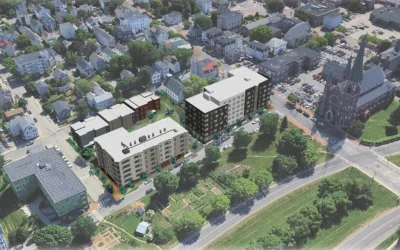
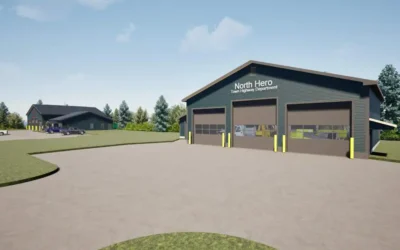
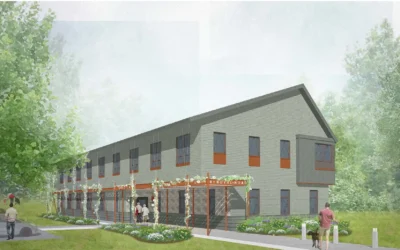
Penacook, NH – A Ground-breaking Ceremony was held on June 2, 2011 for the Penacook Professional Building and will become the future home for Concord Hospital’s Penacook Family Practice. Concord Hospital will lease the 9,600-square-foot building which is located on the former Allied Leather tannery site at 4 Crescent Street. The city sold 2.1 acres to DEW Crescent Street Properties, LLC. after removing contaminated soil and other materials from the site. DEW will serve as both Owner and Construction Manager for the project and plans to build an additional 5,500 square foot addition on the site to lease or sell. The new building will be a single story slab on grade building with wood constructed exterior walls, wood trusses, shingled roof, and cementacius siding. The interior fit-up will be class A finishes in keeping with hospital standards. The project is slated to be complete by November of this year. The Architect is Freeman, French, Freeman, Inc. of Burlington, VT. Photo (From left to right: Mike Francis, DEW; Thomas Bursey, Freeman French Freeman; Jeff Davis, DEW; Dr. Robert Gabrielli, Penacook Family Physicians; Dr. Michelle Spencer, Penacook Family Physicians; Raymond Damante, Esquire; Elden Dube, Mascoma Bank; Wes Reed, Concord Hospital, Domenic Ciavarro, Concord Hospital, Erin Reardon, P.E., Nobis Engineering; Dan Salmonson, DEW; Elizabeth Blanchard, Ward 1 Concord City Councilor)
Projects
Two DEW Projects Receive LEED Certification
Williston, VT– DEW is happy to announce that two projects built by DEW have officially received US Green Building Council LEED certification. On April 25, 2011, Moe’s Southwest Grill received a Silver rating. The 2,900 square foot restaurant, located in Williston, is the first LEED Certified restaurant in Vermont and incorporates several state-of-the-art energy efficient elements. On May 5, 2011, The Putney School Field House project received a Platinum rating (the highest possible rating). The Field House project is 16,800 square foot net-zero energy field house that produces as much energy as it uses over the course of a year. There are only a handful of net-zero energy buildings in the United States-The Putney School Field House is the nation’s first net-zero energy secondary school building and Vermont’s first commercial net-zero energy building. LEED, Leadership in Energy and Environmental Design, is the nationally-accepted standard and rating system for high performance (green) buildings developed by the U.S. Green Building Council.
DEW Construction Corp. & Community College of Vermont Break Ground on New Rutland Academic Center
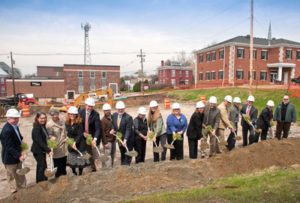
Rutland, VT – A Groundbreaking Ceremony was held on April 26, 2011 for the new Rutland Academic Center for the Community College of Vermont. CCV will be relocating its Rutland campus to a new location at the corner of West Street and Wales Street in downtown Rutland. The new Academic Center is being constructed for CCV with occupancy scheduled for the end of this year, in time for spring semester classes starting January 2012. CCV has entered into a long term lease for approximately 32,500 sq. ft. with developer DEW West & Wales, LLC. The construction manager is DEW Construction Corp. of Williston. CCV selected the site over several other locations, stating the West and Wales location offered a prominent location in addition to on-site parking and the ability to expand as their enrollment continues to grow. “CCV takes its role as a community college very seriously. Our students are your friends, neighbors, relatives, and customers,” said CCV President Joyce Judy. “We are delighted to be able to remain in downtown Rutland, where local businesses will continue to benefit from the 800 students, faculty, and staff CCV brings downtown every week.” The new 3-story building will be constructed from steel and concrete, and have a brick exterior. Many LEED features and energy saving components will be incorporated into the new Class A building. CCV’s new home will house class rooms, […]
DEW Breaks Ground on Bennington State Office Building
Bennington, VT– Gov. Jim Douglas, DEW Construction Corp. and other state officials took part in a groundbreaking ceremony for the Bennington State Office Building project on October 11, 2010. The building was closed three years ago because some people working there were getting sick. State workers are currently working in modular units next to the empty building. The 60,000-square foot project will demolish an older section of the existing structure and gut and renovate a newer portion. Work is expected to be finished by spring 2012. (Pictured above: Peter Hack, VT-BGS; Bill Gallop, Maclay Architects; Mary Lintermann, DEW; Gerry Myers, Commissioner, Buildings and General Services; Alice Emmons, Chair, House Corrections and Institutions Committee; Governor Jim Douglas; Jeff Davis, DEW; Peter Wells, DEW; Ken Hoeppner, DEW and Jim Kelly, DEW.)
Putney School First Net-Zero Commerical Building in Vermont
PUTNEY, VT– The Putney School, DEW Construction Corp. and Maclay Architects, cut the ribbon Saturday, October 10th on its 16,800 square foot net-zero energy field house that will produce as much energy as it uses over the course of a year. There are only a handful of net-zero energy buildings in the United States-The Putney School Field House is the nation’s first net-zero energy secondary school building and Vermont’s first commercial net-zero energy building. Of the project’s $6 million budget,$5.1 million was spent on building construction. “We want to show the world that net-zero energy technology for public buildings exists right now,” says Putney School Director Emily Jones. “It’s time to move net-zero energy buildings from the theoretical realm into reality.” By definition, net-zero energy buildings generate as much energy as they consume over the course of a year. The energy used is usually produced on-site and comes from renewable energy sources such as wind, solar, geothermal, or biomass. These buildings are designed to minimize the use of natural resources and energy. According to Architect Bill Maclay, whose firm designed The Putney School Field House, such buildings not only protect the environment by minimizing energy use and reducing the need for outside (fossil fuel-based) energy sources, they pay for themselves through improved efficiency and lower operating costs and help avoid the risks associated with fuel price volatility. Over the course […]